How to Run a 500-SKU AI Jewelry Design Batch Job (Without Touching Each One)
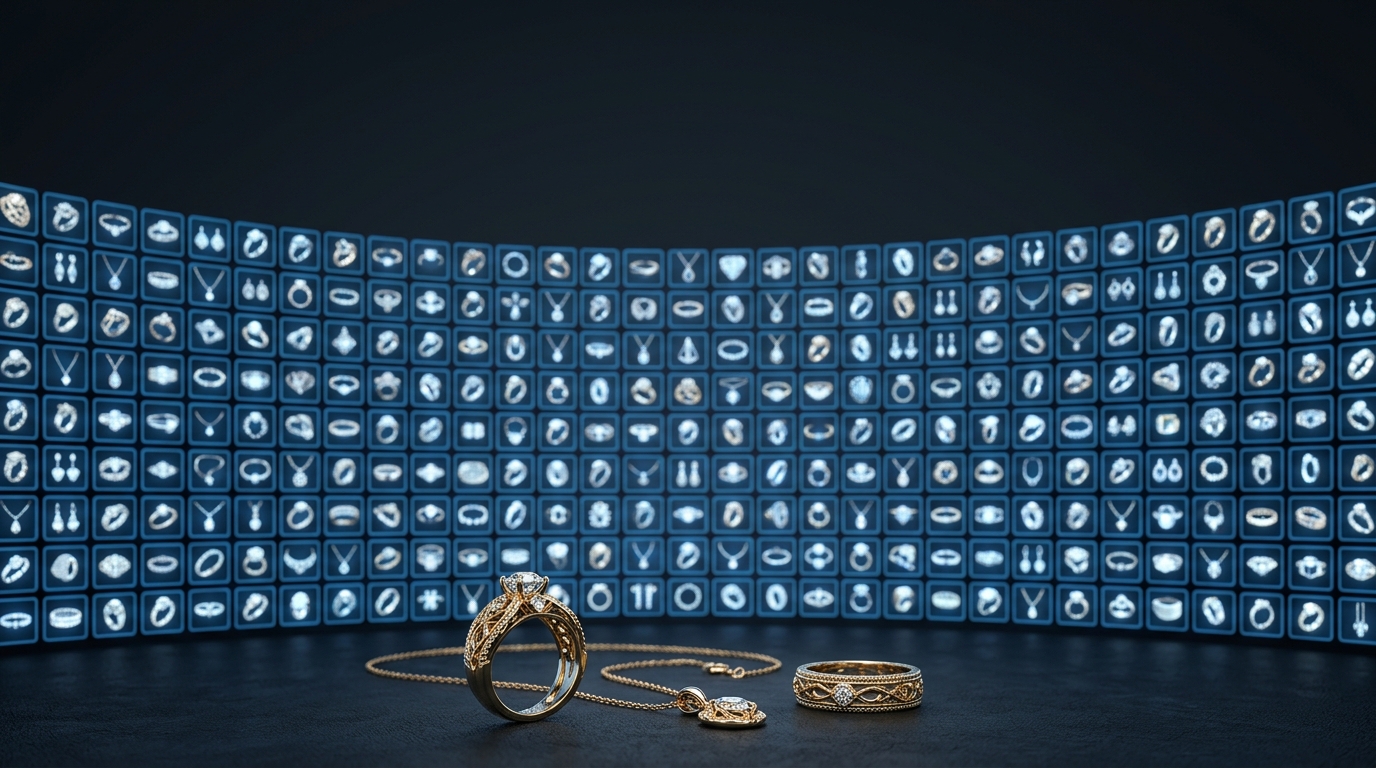
If you've ever tried to generate designs for an entire collection one by one, you know exactly how this goes. You write a prompt, wait, review, tweak, wait again. By the time you've done 20 SKUs you're exhausted and you haven't even touched the stone specs yet.
There's a better way. Diatech Studio has two features most people walk right past: Agent Mode and Bulk CSV Jobs. Together they let you batch out an entire season's catalog overnight — and wake up to a library full of design variations ready for review.
Here's how it actually works.
What's the difference between Agent Mode and Bulk CSV Jobs?
They solve different problems, so it's worth being clear.
Agent Mode is for when you have a creative brief but not individual prompts. You write a high-level description ("delicate rose gold stackable rings with pavé diamonds, 8 variations across different stone shapes"), pick a jewelry category, set how many variations you want (1–10), and hit go. The AI runs the whole thing as a background job while you get on with other work.
Bulk CSV Jobs are for when you have a structured list — a spreadsheet of SKUs, reference image URLs, and per-row generation prompts. You upload the CSV and Studio works through every row, generating designs, marketing copy, or videos, and linking each output back to the right project. One submission, hundreds of results.
Both write results to your project library. Both send you a push notification when they're done.
Setting up a Bulk CSV Job
This is where the real power is for production teams. Here's the exact workflow:
First, prepare your CSV. Each row needs a SKU identifier, an optional reference image URL (useful if you're generating variations of existing designs), and a text prompt. You can also include metadata like category or collection name that gets applied to each generated project.
Upload that to the Jobs page, select your job type (image generation, copy, or video), and submit. Studio queues every row and works through them. You can watch progress in the Jobs page across three tabs — All, Pending, and Completed — and filter by creator, job type, or date range if you're managing a large team's queue.
When the job finishes, you get a push notification on your phone and can download a results CSV with input details, output image URLs, and generated metadata for every row. Every design is already in your project library, tagged with its SKU.
Using Agent Mode for creative exploration
Agent Mode is better when you're at the front of a collection and don't have individual prompts ready. You write the creative brief once and let the AI interpret it across multiple variations.
From the workspace, open Agent Mode, write your brief, select the jewelry categories to cover (rings, necklaces, earrings — pick multiple), and set how many design variations per category. The agent runs as a background Job, so you can close the tab, switch to another project, or go make coffee.
It's especially good for:
- Quickly filling a moodboard before a client meeting
- Generating style-exploratory drafts before locking a brief
- Running overnight when you've finished your actual workday
The results land in your Jobs queue when done, each output linked to a new project automatically.
Reviewing the results without chaos
Here's the thing about batch generation — if 200 designs land in your library and you have no system for reviewing them, you've just created a different kind of overwhelm.
A few things that help:
Bulk actions in the library. After your job completes, you can filter the library by creation date and bulk-select all new projects. From there you can bulk-add them to a catalog, bulk-export the metadata to a spreadsheet, or bulk-delete anything obvious. Much faster than one at a time.
The Discover tab. If you're on a team, every generated project shows up here automatically. Collaborators can browse, rate designs with a thumbs up or down, and add annotation feedback — without needing to be the person who ran the job.
Catalog curation. Once you've reviewed the batch, add the approved designs to a catalog. From there you can run the presentation deck straight to your client, or export PPTX for an offline meeting.
How many credits does this actually cost?
Each generated image costs credits, same as any manual generation. The difference with batch jobs isn't that they're cheaper per image — it's that the time cost collapses to near zero. You're paying the same credit rate but doing it unattended.
For teams with high volume, the per-member credit caps in Team Management let admins set limits so a runaway CSV job doesn't blow through the monthly allowance overnight.
A real workflow example
Say you're preparing a 500-SKU ring catalog for a wholesale buyer meeting in two weeks. Here's roughly how this looks in practice:
- Pull your SKU list from your ERP or spreadsheet. Add a prompt column — even rough descriptions work, the AI handles interpretation.
- Upload as a Bulk CSV Job. Select image generation. Submit before end of day.
- Wake up to 500 design images in your library, each tagged with its SKU.
- Bulk-add to a catalog. Run the Suggested Projects feature to fill any gaps.
- Use Targeted Edit for specific SKUs that need stone or setting adjustments.
- Export the catalog as PPTX or PDF for the buyer meeting.
What used to take a team a week of back-and-forth now takes one overnight job and a morning of review.
The bottom line
Batch generation isn't a shortcut to lower quality — it's the only way to handle collection-scale volume without burning out your design team. The designs still go through your review process, still get annotated and approved, still land in a curated catalog. The AI just does the grunt generation work while you sleep.
If your team is still generating designs one at a time for large collections, Agent Mode and Bulk CSV Jobs are probably the two features worth trying first. Set up a test batch tonight. The results will be waiting for you in the morning.