AI Necklace Design: Generate Pendants, Chains, and Statement Pieces in Minutes
Necklaces are the piece every jewelry client has an opinion about and the hardest category to design from a verbal brief. "Something elegant but not boring" does not narrow it down. "A delicate chain with a stone that pops but also works for everyday" describes roughly half the necklace market.
AI necklace design changes this because you can generate from vague descriptions and iterate from reactions. Instead of asking a client to be precise, you can show them four interpretations of "elegant but not boring" in two minutes and ask which direction is closest.
Here's a category-by-category breakdown of necklace styles with prompt examples for each.
Solitaire Pendants
The most searched necklace category for a reason. Clean, versatile, easy to price, easy to explain.
A single round brilliant diamond solitaire pendant in a four-prong white gold bezel setting, suspended on a 1mm delicate cable chain, studio photography on white background, crisp and clean
For an oval stone variation: Oval diamond pendant, slim four-prong yellow gold setting, tapered bail, delicate 16-inch chain, warm light, slight shadow beneath to suggest depth
The stone shape is the most powerful variable here. Round reads timeless. Oval reads feminine and elongating. Marquise reads vintage-forward. Just swap the stone name in the prompt and regenerate.
Layered and Station Necklaces
One of the biggest 2026 trends is layering — multiple chains at different lengths, with stations, with pendants. These are harder to describe but generate beautifully with the right prompt.
Three-layer gold station necklace with graduating round diamond stations — 14 inches, 16 inches, and 18 inches — yellow gold, worn together, warm editorial lighting
For a more subtle take: Delicate gold chain necklace with five evenly-spaced diamond bezels, 16 inches, white gold, everyday minimal, soft diffused light
Chokers
Choker necklaces sit at the collarbone and communicate very differently from longer chains. They read confident, fashion-forward, sometimes edge.
Diamond pavé choker necklace in white gold, 14 inches, flexible linked design, continuous sparkle, sits close to the throat, editorial lifestyle lighting
For a non-diamond version: Hammered yellow gold choker with a single baroque pearl drop at center, 14 inches, organic texture contrasting with smooth pearl, organic and modern simultaneously
Lariat and Y-Necklaces
The lariat is the necklace that wears as effortlessly as it looks. That long chain, the Y-drop, the way it moves.
Gold lariat Y-necklace, long 32-inch chain ending in a dangling pear-cut diamond teardrop, 18k yellow gold, sophisticated and elongating, soft focus background
A modern take on the classic: Rose gold lariat necklace with a twisted chain body and a bezel-set oval morganite drop, romantic and warm, evening-appropriate
Cluster and Statement Pendants
When a solitaire isn't enough and the client wants presence.
Flower cluster pendant, round center diamond surrounded by six petal-shaped petals each set with a marquise diamond, white gold, slightly vintage, 18-inch chain
For an architectural, modern cluster: Geometric cluster pendant in yellow gold, irregular arrangement of mixed-cut diamonds in round, baguette, and trillion cuts, contemporary and art-forward
Baroque Pearl Necklaces
Baroque pearl prompts work surprisingly well and produce some of the most distinctive results.
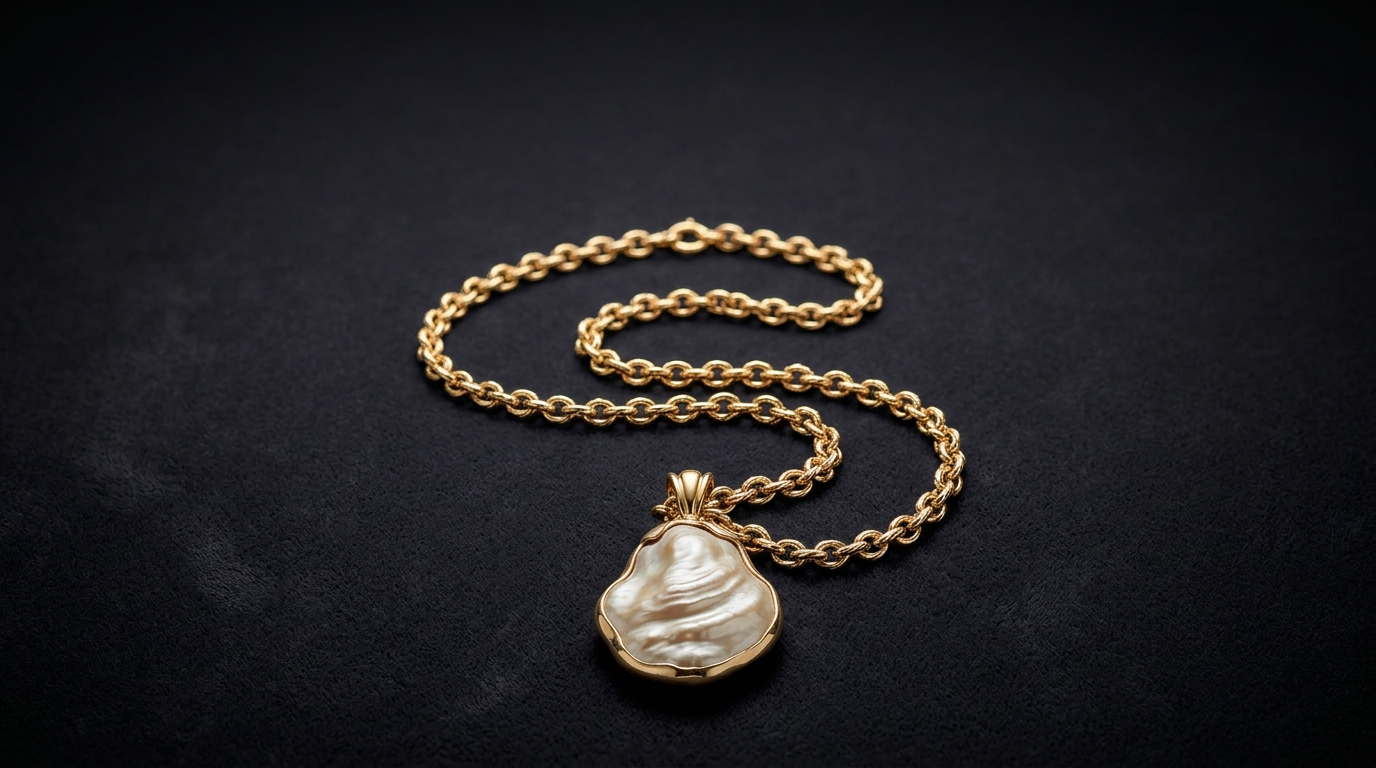
Large irregular baroque south sea pearl pendant wrapped with thin 18k gold wire, hanging from a 16-inch gold chain, luxurious and organic, warm studio lighting
For a multi-pearl design: Baroque freshwater pearl strand necklace, mixed sizes from 8mm to 16mm, graduated, knotted on ivory silk cord with a gold box clasp, warm vintage feel
Getting the Chain Right
One thing a lot of designers miss: describing the chain is as important as describing the pendant. "Cable chain," "figaro chain," "rope chain," "box chain," "curb chain" — each changes the weight and character of the piece significantly.
If your reference is "delicate," use cable or box. If it's "substantial," use rope or curb. Add the chain description to any pendant prompt and the generated image will be much more specific.
Using Reference Images
If you're reinterpreting an existing necklace — adding stones to a plain chain, updating a vintage piece, or creating a variation of a bestseller — upload the original as a reference image and describe the changes you want. The AI uses the uploaded piece as a visual anchor and applies the modifications you describe.
This is consistently faster than starting from text alone when you already have a piece that's "close" to what you want.
Multiple Angles for Necklace Details
Once you have a necklace you like, use Multiple Angles to capture detail views. A close-up of a clasp, a profile view of a pendant bail, a slightly elevated angle showing how a layered piece falls — these are useful for both client presentations and production briefs.
The front view shows the overall design. The angle views show whether it works in three dimensions.
Start generating at studio.diatech.ai.