From Sketch to Showroom: Streamlining Jewelry Ideation with AI Generation and Editing
Related: AI jewelry design
The journey from a flickering spark of inspiration to a physical piece of jewelry sitting in a velvet-lined display case is often long, arduous, and fraught with technical bottlenecks. For decades, the "ideation" phase has been the most volatile part of the creative process. A designer might have a brilliant concept, but translating that vision into something a client can visualize—or a workshop can produce—traditionally requires hours of manual sketching, moodboarding, and high-fidelity CAD rendering.
In the fast-paced modern market, these traditional timelines are becoming a liability. Design teams are under immense pressure to innovate faster, respond to micro-trends, and provide personalized experiences for clients without sacrificing the artistry that defines the craft. This is where AI jewelry ideation is fundamentally rewriting the rules of the studio.
By integrating artificial intelligence directly into the creative workspace, designers are no longer limited by the speed of their hands or the constraints of traditional software. We are entering an era where a rough napkin sketch or even a spoken description can be transformed into a photorealistic concept in seconds.
At Diatech Studio, we’ve built an AI-powered ecosystem specifically to bridge the gap between "what if" and "here it is." This guide explores how jewelry teams can leverage multimodal inputs and high-precision editing to move from initial concept to showroom-ready designs with unprecedented speed.
The New Creative Starting Line: Multimodal Inputs for Starting Ideas
Traditionally, every design started the same way: a pencil hitting paper or a cursor clicking in a CAD environment. While these methods are tried and true, they are often siloed. A designer might have a great voice memo from a client meeting, a Pinterest board of textures, and a rough sketch, but bringing them together into a cohesive design is a manual chore.
The power of modern AI jewelry ideation lies in its "multimodal" nature. This means the AI doesn't just read text; it understands visual cues, structural layouts, and even spoken intent.
From Text and Speech to Visual Reality
Sometimes the best ideas come when you aren't at your desk. You might describe a "vintage-inspired halo ring with organic, vine-like filigree and a pear-cut emerald center" into your phone. In the past, you’d have to wait until you could sit down and sketch that. With Diatech Studio, jewelry ideation from text or speech with AI allows you to input those exact words and see multiple visual interpretations instantly. This serves as a "visual shorthand," allowing designers to test the viability of a concept before committing to a technical drawing.
Enhancing the Humble Sketch
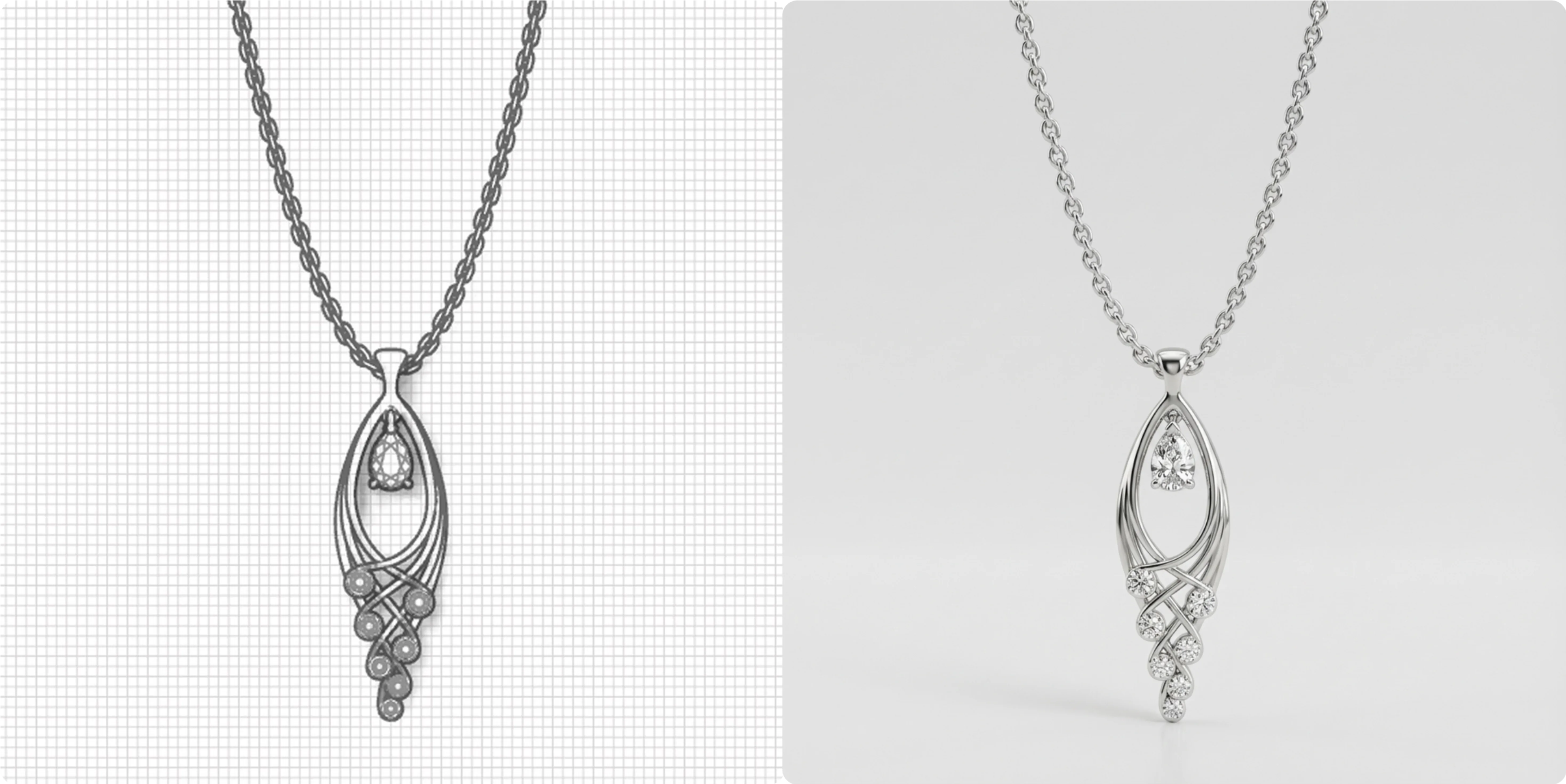
Hand sketching remains the soul of jewelry design. However, the leap from a 2D graphite sketch to a 3D-looking presentation can take hours of shading and coloring. One of the most transformative features of the Diatech workspace is the ability to generate jewelry designs from sketches.
You can upload a quick thumbnail sketch—no matter how rough—and use AI to "render" it. The AI maintains your original composition and proportions but adds realistic lighting, material textures (like 18k gold or platinum), and gemstone refractions. This keeps the designer's "hand" in the work while automating the tedious task of rendering.
Bridging CAD and AI
For more technical teams, the ideation process often involves existing CAD files. Instead of starting from scratch for every new collection, you can upload a base CAD silhouette and ask the AI to "reimagine" the surface details or stone layouts. This hybrid approach ensures that the resulting designs are not just "pretty pictures" but are grounded in the technical geometry you already know works for production.
Agentic Variation Generation: The Infinite Moodboard
Once the initial seed of an idea is planted, the next challenge is exploration. A client might like a design but wonder, "What if the band was thinner?" or "What if we used baguettes instead of round brilliants?" In a traditional workflow, exploring ten variations of a single ring could take a full workday.
With AI variation generation jewelry tools, that exploration happens in real-time. This is what we call "Agentic Generation"—where the AI acts as a creative partner that can propose meaningful alternatives based on your aesthetic direction.
Creating Endless Options with "Prompt Snippets"
One of the biggest hurdles in using AI for jewelry is the "blank box" problem—not knowing exactly what to type to get a professional result. Diatech Studio solves this with over 400 built-in prompt snippets. These are pre-engineered fragments of "design language" that understand jewelry-specific terms like milgrain edges, pavé settings, cathedral shanks, or Art Deco geometry.
By clicking these snippets, designers can instantly steer the AI toward professional outcomes without needing to be "prompt engineering" experts. It’s like having a library of every setting style and metal finish at your fingertips.
Automatic Web-Inspired Remixes and Moodboarding
Jewelry doesn't exist in a vacuum. Designers are constantly inspired by fashion, architecture, and nature. Diatech allows teams to pull inspiration from web-based references and "remix" them into their own unique design language.
Imagine you are designing a collection inspired by the fluid lines of Gaudi’s architecture. You can upload images of the Casa Batlló alongside your jewelry sketches. The AI can then "cross-pollinate" these styles, generating variations that incorporate the architectural curves into the ring's shank or the earring's silhouette. This moves beyond simple copying and into true algorithmic creativity.
The Power of the "Variation Loop"
The goal isn't just to produce a lot of images; it's to find the perfect design. The variation loop allows you to:
- Select a "Hero" image: Pick the design that is 80% there.
- Iterate on specific elements: Tell the AI to keep the stone but vary the metalwork.
- Generate "Families": Quickly create matching earrings and pendants based on a successful ring design to build out a full collection in minutes.
High-Precision Refinement: Turning Concepts into Blueprints
The criticism of early AI design tools was that they were "random." You could get a beautiful image, but you couldn't change just one specific part of it. If the AI generated a beautiful necklace but the clasp was wrong, the whole image was useless.
Precision is the difference between a toy and a professional tool. To make AI jewelry ideation viable for a high-end brand, the designer must remain in total control of the final output.
Targeted Edits with Lasso Selection
Diatech Studio introduces high-precision refinement tools that allow for granular control. Using a "Lasso" or masking tool, a designer can circle a specific area of a generated design—say, the prongs of a ring—and type a command to "Change these to double-claw prongs."
The AI updates only that specific selection, leaving the rest of the design perfectly intact. This level of control is essential for professional workflows where every millimeter matters.
Text-Guided Adjustments
Sometimes, you don't need to redraw; you just need to "tweak." Text-guided editing allows you to provide feedback to the AI as if you were talking to a junior designer.
- "Increase the saturation of the sapphires."
- "Make the shank 20% thicker."
- "Add a hidden halo under the center stone."
This iterative process ensures that the final concept is exactly what the designer envisioned. It bridges the gap between the "wild" creativity of AI and the "strict" requirements of jewelry manufacturing.
From 2D Concept to Production-Ready Assets
Once the ideation phase is complete and a design is finalized, the workflow doesn't stop there. The high-fidelity images generated in Diatech Studio are "market-ready." They can be used in design decks for internal approval, sent to clients for pre-sales, or used as a perfect visual reference for the CAD team. By providing a photorealistic "north star," the designer eliminates the guesswork that often leads to multiple costly CAD revisions.
Conclusion: The Future of the Design Studio
The integration of AI into the jewelry design process isn't about replacing the designer; it’s about liberating them. By automating the heavy lifting of rendering, varying, and moodboarding, AI jewelry ideation allows creative teams to spend more time on what truly matters: the story, the soul, and the strategy of their collections.
We’ve seen that the transition from a rough sketch to a showroom-ready concept no longer needs to take weeks. With Diatech Studio, that journey is compressed into a collaborative, high-speed dialogue between human intuition and machine intelligence. This speed translates directly into a competitive advantage—allowing brands to be more responsive to their customers and more daring in their designs.
As we look toward the future of jewelry, the most successful studios will be those that embrace these tools to enhance their craftsmanship. Whether you are a solo artisanal jeweler or a design director for a global brand, the ability to ideate at the speed of thought is now within reach.
Summary Recap
- Multimodal Input: Start your designs using text, voice, rough sketches, or existing CAD files.
- Rapid Variation: Use agentic AI and 400+ prompt snippets to explore hundreds of design directions in minutes.
- Precision Editing: Use Lasso tools and text-guided refinement to control every detail of the design.
- Workflow Efficiency: Reduce the time from concept to showroom, eliminating bottlenecks in the rendering and CAD revision phases.
FAQ
1. Can AI jewelry ideation really understand technical jewelry terms? Yes. Unlike general AI tools, Diatech Studio is built with a jewelry-specific focus. It understands terms like "milgrain," "tension setting," "bezel," and "marquise cut," allowing for professional-grade results.
2. How do I generate jewelry designs from sketches if my drawing skills are poor? The AI doesn't need a masterpiece. Even a "stick-figure" level sketch of a ring’s layout provides enough structural information for the AI to understand placement, scale, and perspective. The tool does the heavy lifting of rendering lighting and materials.
3. Is the AI variation generation jewelry unique, or does it copy existing designs? The AI generates original imagery based on the patterns it has learned. By using your own sketches or specific prompt snippets, you are creating unique iterations that haven't existed before.
4. Can I use these AI-generated images for my website or marketing? Absolutely. One of the biggest benefits of Diatech Studio is that it generates market-ready, photorealistic content that can be used for social media, line sheets, and client presentations even before the piece is physically manufactured.
5. How does jewelry ideation from text or speech with AI help in client meetings? It allows for "live design." When a client describes a dream piece, you can input their description into Diatech and show them visual options instantly. This increases client confidence and significantly shortens the sales cycle.
Ready to transform your design process? Stop letting technical bottlenecks slow down your creativity. Experience the power of AI-driven design and see your ideas come to life in seconds.
Related: AI jewelry design